

Behold, I Am With You
Series:
New Testament
Book:
Genesis

Rev. Budy Setiawan
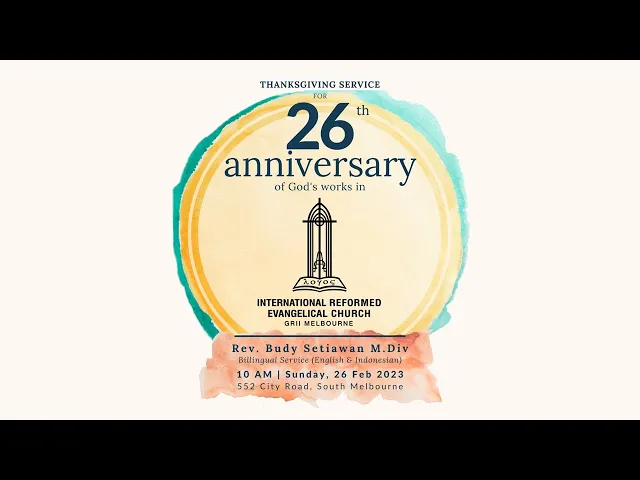
Preached on the 26th anniversary of IREC Melbourne, the sermon takes Genesis 28:1-5 and 10-22 as its text: Jacob's departure from Isaac's household with a legitimate blessing, and his subsequent dream at Bethel. The sermon opens by noting the contrast between how Jacob first received Isaac's blessing — through deception, impersonating Esau — and how he now leaves, blessed openly and rightly by his father to seek a wife among Laban's household. This blessing echoes the covenant given to Abraham and then Isaac: fruitfulness, multiplication, and the promise that Jacob's offspring will become "a company of peoples," a phrase whose Hebrew root (qahal) becomes ekklesia in Greek, the word from which "church" derives. The sermon argues that God's promise to the patriarchs is nothing less than the founding promise of the church itself, alongside the promised land Jacob now, ironically, has to leave.
Verse 11's detail that Jacob stopped "because the sun had set" is read as more than incidental scene-setting. The sermon argues the author uses it symbolically: the sun remains set over Jacob's life from this point until Genesis 32, when he wrestles with God at the Jabbok and dawn finally breaks — roughly forty years of exile from home and inheritance, a consequence of his own scheming and deceit. Yet even in this long night, the sermon insists, God does not abandon Jacob but meets him with startling, undeserved grace.
The central interpretive move is a contrast between Bethel and Babel. The sermon traces the Babel narrative of Genesis 11, noting that the name itself, though it sounds in Hebrew like "confusion," derives from the Akkadian Babilu, "gate of God" — the builders wanted their tower's summit to function as heaven's gate. Citing Old Testament scholar Derek Kidner, the sermon frames Babel's grandiosity as an expression of humanity's perennial spirit: a "let us make a name for ourselves" project that, beneath its confidence, betrays deep insecurity. People who must search for a name, the sermon argues, are people who do not yet know who they are — a self-defeating contradiction, since sinful humanity tries to construct identity, security, and significance purely from its own resources, gathered together in the false safety of numbers. God's judgment against this project is deliberately unspectacular: no earthquake, no volcano, simply confused language, illustrated with a picture of two people literally unable to understand each other, rendering the shared project impossible.
Bethel is presented as the true gate of God that Babel never was. Everything the Babel-builders strove to manufacture — security, name, significance — is given to Jacob for nothing, purely as grace, precisely when he has lost everything and has no claim on it. Verse 15's promise, "I am with you and will keep you wherever you go," supplies the security Babel sought through unity and self-assertion; verse 14's promise of offspring "like the dust of the earth" supplies the significance Babel sought through its tower. The sermon underscores that this is the same covenant God made with Abraham in Genesis 12 — "I will make your name great" — arriving immediately after Babel's failed self-naming, driving home that whatever worth or security a person possesses comes only by God's initiative, never by human striving.
The sermon then moves to Christ, quoting John 1:51, where Jesus tells Nathanael that he will see heaven opened and angels ascending and descending on the Son of Man. Jacob's ladder, the sermon argues, is not Jacob's ladder at all but God's own ladder, let down from heaven to earth for people who have no claim on it — fulfilled completely in Christ, the only way to the Father, whose death tore the temple curtain and opened access to God once for all.
Turning application inward, the preacher shares a personal story of pique at being assigned only half a speaking session at a conference despite the travel and cost involved, and the subsequent conviction that his irritation exposed pride — mistaking the privilege of serving for a measure of his own importance. This becomes a call for the congregation to examine any tendency to credit its 26 years of fruitfulness to human effort rather than grace, invoking Psalm 127's "unless the Lord builds the house." The sermon closes by looking forward: expansion plans for adjoining space, an eventual second English-language pulpit, and the church's ongoing shift from an Indonesian-only congregation toward multilingual ministry (English, and potentially Mandarin), framed throughout as a call to total, self-denying commitment — echoing Jacob's own vow in verse 20 — done for God's glory alone rather than institutional pride.
Bible Verses Used
Genesis 28:1-5: Isaac's legitimate blessing over Jacob, contrasted with the earlier blessing obtained by deceit, and shown to renew the Abrahamic covenant.
Genesis 28:10-22: The core text — Jacob's dream at Bethel, God's promise of presence and blessing, and Jacob's vow, read as the fulfillment pattern for security and significance found only in grace.
Genesis 11 (Tower of Babel): Used as the dark backdrop to Bethel, exposing humanity's self-made pursuit of name, security, and significance as ultimately confused and self-defeating.
Genesis 12: God's promise to Abraham to make his name great, shown to directly answer the self-naming ambition of Babel one chapter earlier.
John 1:51: Jesus's words to Nathanael identifying himself as the true ladder between heaven and earth, fulfilling Jacob's vision at Bethel.
Psalm 127 (referenced, "unless the Lord builds the house"): Applied to the church's 26-year history to insist that all growth and success are God's work, not human achievement.
Read more
Previous
Visions of Conquest
Next
