
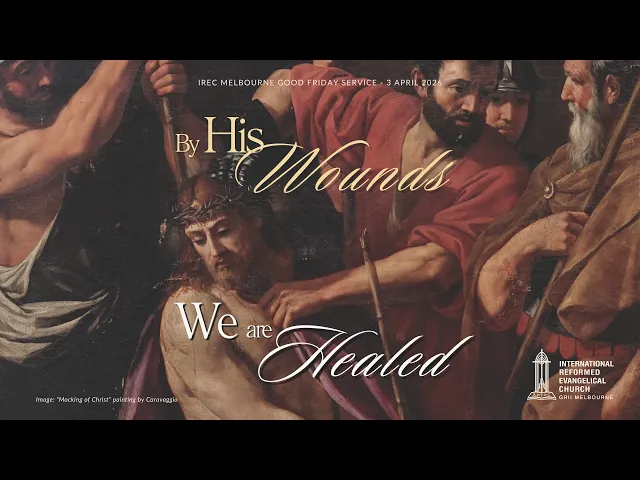

By His Wounds We Are Healed - Good Friday Service
Series:
New Testament
Book:
Isaiah

Rev. Budy Setiawan
Preached on Good Friday, the sermon opens by reading two passages side by side: Mark 2:1-12, the healing of the paralytic, and Isaiah 52:13-53:6, the prophecy of the suffering servant. The preacher argues that no passage in the Old Testament more clearly foretells the gospel of Jesus Christ than Isaiah 53, and he sets out to trace three messages the prophet Isaiah proclaims before returning to Mark's account of Jesus and the paralytic to show how they meet in Christ.
Before unpacking the prophecy, the sermon asks who exactly is meant by "the servant of the LORD." In places, Isaiah applies the title to the nation of Israel itself ("you, Israel, my servant, Jacob whom I have chosen," Isaiah 41:8), and elsewhere to Isaiah as a prophet, formed from the womb to be a servant (Isaiah 49:5). But Isaiah 53:5, with its language of "he was pierced for our transgressions," clearly cannot refer to Israel or to Isaiah, since the "our" there means Israel and Isaiah are the ones being spoken for, not the one doing the suffering. There must be another servant, one who suffers in Israel's place and Isaiah's place. The New Testament resolves the question plainly: 1 Peter 2:24 quotes Isaiah 53 directly of Christ, "he himself bore our sins in his body on the tree," and in Acts 8 the Ethiopian eunuch is reading this very passage, unable to tell whether the prophet speaks of himself or another, until Philip opens his mouth and, beginning from that Scripture, preaches Jesus to him.
With the servant identified as Christ, the sermon draws out three messages from Isaiah. The first is the reality of human rebellion: "we all, like sheep, have gone astray; we have turned every one to his own way" (Isaiah 53:6). This, the preacher insists, is the root of every problem Israel or we ourselves face — not primarily circumstance or suffering but rebellion against God, the insistence on doing life our own way. Until this is admitted before God, no true resolution to our deepest struggles is possible. The second message is that the servant sent to address this rebellion is himself despised and rejected — "he had no form or majesty that we should look at him... he was despised and rejected by men" (Isaiah 53:2-3). The third message, and the heart of the sermon, is that our salvation, and especially our spiritual healing, comes only because this servant was crushed and pierced in our place: "he was pierced for our transgressions... and with his wounds we are healed" (Isaiah 53:5).
The sermon then returns to Mark 2, dwelling on the strangeness of Jesus' first response to the paralytic lowered through the roof: not physical healing, but "Son, your sins are forgiven." The scribes call this blasphemy, since only God can forgive sin, and Jesus meets their objection with a question — which is easier, to forgive sins or to command a paralyzed man to rise and walk? The sermon argues that in one sense forgiveness is "easier" to claim since no one can verify it, yet for Christ himself it was in fact far costlier to pronounce, since granting it meant paying for it with his own death on the cross. The paralytic assumed his deepest need was to walk again; Jesus exposes a need deeper still. The point is illustrated with two stories — Albert Camus's account of a wife whose stolen night of excitement in the city leaves her only emptier, and C.S. Lewis's Eustace in the Narnia books, who becomes a dragon and cannot peel away his own scales no matter how he tries, until Aslan claws down past every layer, a painful but necessary work that only the Christ-figure can do. Both illustrate that whatever we imagine will satisfy us, if obtained apart from Christ, will not fill us but hollow us further.
The sermon closes by tying the suffering servant back to the cross: the eternal Son, in perfect union with the Father, was forsaken and crushed so that those who trust him might be counted righteous, cleansed by his blood, and made new. As the congregation moves toward the Lord's Table, the preacher urges them not merely to have heard the gospel again but to see, touch, and taste it in the bread and the cup, remembering that Christ's body was given and his blood poured out so that they might live no longer for their own will but for his, and there find the deepest satisfaction of their souls.
Bible Verses Used
Mark 2:1-12: The paralytic lowered through the roof frames the whole sermon; Jesus' pronouncement "your sins are forgiven" before any physical healing reveals that humanity's deepest need is forgiveness, not merely relief of circumstance.
Isaiah 52:13-53:6: The central suffering-servant prophecy, read as foretelling Christ's substitutionary death seven hundred years in advance.
Isaiah 53:6: "We all, like sheep, have gone astray" is used to name humanity's root problem as rebellion against God rather than external suffering.
Isaiah 53:2-3: Describes the servant as despised and rejected, establishing that the one who saves Israel is himself scorned by Israel.
Isaiah 53:5: "He was pierced for our transgressions... with his wounds we are healed" is the sermon's key text for substitutionary atonement and true spiritual healing.
Isaiah 41:8: Cited to show that "servant" sometimes refers to the nation of Israel, raised only to be set aside as the referent of Isaiah 53.
Isaiah 49:5: Cited to show that "servant" can also refer to Isaiah the prophet himself, likewise ruled out as the referent of Isaiah 53:5.
1 Peter 2:24: Quoted as New Testament confirmation that the suffering servant of Isaiah 53 is Jesus Christ, who bore sin in his body on the cross.
Acts 8:34-35: The Ethiopian eunuch's question about who Isaiah 53 describes, answered by Philip preaching Jesus from that very text, used to anchor the servant's identity in apostolic preaching.
Read more
Previous
Knowing His Death and Resurrection
Next
