
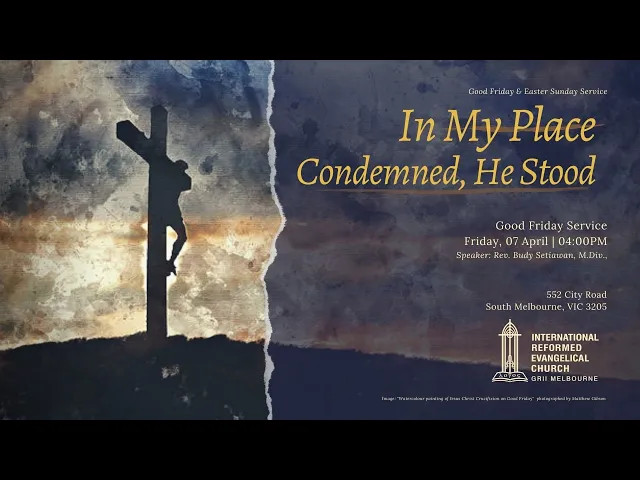

In My Place Condemned, He Stood
Series:
New Testament
Book:
Romans

Rev. Budy Setiawan
The sermon, preached on Good Friday, opens with a story of a chaplain who asks a room of hardened, wounded prisoners who killed Jesus Christ. After the men answer Pilate, Judas, the chief priests, or Herod, the chaplain answers that ultimately it was the Father himself, in fulfillment of his own will. This anecdote frames the sermon's theme, drawn from the hymn line "in my place condemned he stood," and introduces the doctrine of penal substitutionary atonement: that Christ suffered and died bearing God's punishment and wrath in the place of sinners, so that those united to him would not perish but receive eternal life, as 2 Corinthians 5:21 declares — "God made him who had no sin to be sin for us, so that in him we might become the righteousness of God."
The sermon acknowledges that this doctrine, though long central to the church's faith, faces mounting objections today, citing Bishop John Shelby Spong's rejection of "a deity who required the sacrifice of his son." Rather than build a straw man to knock down, the sermon works carefully through three common criticisms in order to deepen the congregation's grasp of the doctrine's depth.
The first criticism holds that a wrathful God needing appeasement resembles ancient pagan religion, and reflects a broader discomfort with the idea of God's wrath — a discomfort traced back to the rise of liberal theology, quoting Richard Niebuhr's description of a God "without wrath" bringing people "without sin" into a kingdom "without judgment" through a Christ "without a cross." Against this, the sermon insists Scripture is unambiguous that God's wrath against sin is real, citing Romans 1:18 ("the wrath of God is revealed from heaven against all ungodliness and unrighteousness of men"). It traces the objection to a deeper root: a trivializing of sin's seriousness, arguing that because people compare themselves favorably to worse sinners, they underestimate their guilt before God. Drawing on Jonathan Edwards, the sermon explains that the gravity of an offense depends on the dignity of the one offended — wronging a parent is serious, wronging a president more so, but wronging God, the most exalted being of all, incurs guilt with no possible earthly measure, hence "the wages of sin is death." The sermon insists God's holiness and wrath do not contradict his love; his wrath, unlike sinful human anger rooted in wounded ego, is a righteous, controlled response to sin, quoting the hymn "Alas and Did My Savior Bleed" — "Ye who think of sin but lightly... here its guilt may estimate" — to reinforce that the cross itself reveals how serious sin truly is.
The second criticism asks how Christ's death as sacrifice differs from pagan practices of appeasing angry gods with offerings. The sermon identifies two decisive differences: in Christ's death, it is not humanity offering a sacrifice to God, but God himself sending his own Son; and Christ's death is not a means of earning God's love but an expression of a love God already has, unlike pagan sacrifice offered to obtain favor.
The third criticism concerns apparent conflict within the Trinity — how can a Father who eternally loves the Son pour out wrath upon him, especially given Gethsemane's prayer, "let this cup pass from me," and the cry from the cross, "My God, my God, why have you forsaken me?" The sermon affirms the Father and Son are perfectly united in will and love, so no true conflict can exist between the persons of the Trinity, framing the Son's willing self-giving (John 10:18, "no one takes my life from me... I lay it down of my own accord") alongside the Father's grief, comparing it to a parent's anguish at a suffering child, as itself a mysterious expression of shared suffering, not division.
A further concern is how it can be just for a righteous Christ to die for the guilty, invoking Proverbs 17:15 against justifying the wicked. The sermon resolves this through the doctrine of union with Christ: Christ's death satisfies justice — Romans 3:25-26 — only for those united to him by faith, functioning representatively (2 Corinthians 5:15), much as an ambassador's signature binds an entire nation. Quoting Martin Luther, who called Jesus "the greatest sinner who ever lived" in the sense that God treated him as bearing every sin imaginable, the sermon insists this is fully just because Christ genuinely bore those sins on the cross for those who trust him — while those outside Christ still bear God's justice themselves, eternally.
The sermon closes urging listeners to examine whether they are truly united to Christ by faith, and to let the horror of what Christ endured — physical torment, but above all the cup of divine wrath drained to the last drop — increase their hatred of sin and gratitude for a love expressed at infinite cost.
Bible Verses Used
Romans 1:18: Opens the sermon's case that God's wrath against sin is a clear, repeated scriptural reality, not an invention to be softened away.
Romans 3:25-26: Central proof text showing Christ's death as propitiation both demonstrates and satisfies God's justice for those who have faith.
Isaiah 53:2-6, 10: Read at the outset to establish Christ as the suffering servant who bears others' sickness, transgression, and iniquity by God's own will.
2 Corinthians 5:21: The controlling verse of the sermon's thesis — Christ, sinless, made sin for us so we might become the righteousness of God.
2 Corinthians 5:15: Grounds the representative logic of substitution — Christ died for all who are united to him, so they are reckoned as having died with him.
Proverbs 17:15: Raised as the justice objection — condemning the righteous is an abomination — which the sermon resolves via union with Christ.
Hebrews 10 (vengeance is the Lord's): Explains why believers do not repay evil with evil, since final justice and retribution belong to God alone.
John 10:18 (referenced): Supports that Christ's death was fully voluntary, not imposed against his will, preserving unity within the Trinity.
Galatians 2:20 (referenced): Describes the believer's resulting identity — "it is no longer I who live, but Christ who lives in me" — as the fruit of union with Christ's substitutionary death.
Read more
Previous
Genealogy of Jesus Christ
Next
