
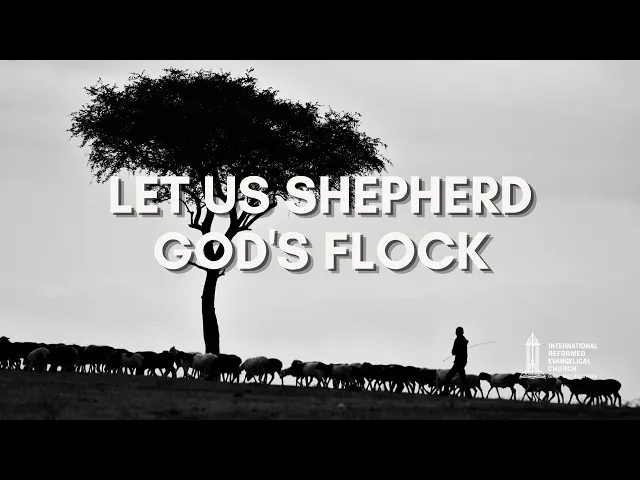

Let Us Shepherd God's Flock
Series:
New Testament
Book:
1 Peter

Rev. Lim Yi Jin
The sermon argues that God appoints elders to shepherd his people according to the pattern of Jesus Christ, the chief Shepherd. In 1 Peter 5:1-4, Peter addresses all elders, including those who teach and those who rule, and commands them to shepherd the flock of God. The responsibility of pastoral care therefore belongs to the whole eldership, not only to ordained preaching elders. Christ gives this shepherding responsibility to the apostles, and the apostles entrust it to the elders who oversee the local church.
Because Jesus is the chief Shepherd and elders are lesser shepherds, their ministry must imitate his shepherding care. The shepherding metaphor means that church leadership is governed by Scripture, centered on souls, and exercised through personal relationships. Elders do not possess independent authority. They remain sheep under God's authority and must lead others by directing them to the Word and to Christ.
First, elders shepherd by teaching God's Word. Jesus sees the crowds as sheep without a shepherd and responds by teaching them. Biblical teaching feeds God's people, guides them onto the right path, and protects them from sin, error, and temptation. Preaching, counseling, prayer, and personal conversations all belong to this ministry of the Word. Consequently, elder ministry must be constrained by Scripture. Elders must not bind consciences with human traditions or personal preferences, but must exercise spiritual authority only according to God's revealed truth.
Second, elders shepherd by caring for the souls entrusted to them. Church leadership is not fundamentally corporate management, military administration, or project coordination. The church is the household of God, so elders lead more like faithful fathers than like business executives. The qualifications for eldership in 1 Timothy 3 show that a man's ability to manage his household provides evidence of his ability to care for God's church. Such care involves patience, loving discipline, personal knowledge, prayer, instruction, and perseverance. Since each member has distinct struggles and circumstances, shepherding cannot be reduced to programs or impersonal systems.
Third, elders shepherd by exercising oversight without domineering. They are called to watch over God's people as beloved sons and daughters, not as employees or subjects. Their authority is gentle, exemplary, and pastoral rather than coercive. The image of the shepherd's rod illustrates the responsibility to account for every sheep. Elders must know who belongs to the flock, care for those under their charge, and recognize when someone is absent or wandering.
This responsibility requires practical structures. A reliable membership list helps elders remember names and faces, pray for every member, and ensure that no one is forgotten. Regular fellowship and pastoral visits enable elders and small group leaders to understand members' spiritual conditions. Special attention must be given to those who are isolated, infrequently present, difficult to know, or resistant to fellowship. Love pursues wandering sheep rather than caring only for those who regularly appear. Small group leaders and care ministries can assist the elders, but they do not replace the biblical office of the elder.
The sermon also connects shepherding with the distinction between elders and deacons. Acts 6 shows that practical service is important, yet the apostles appoint others to oversee that work so that they can remain devoted to prayer and the ministry of the Word. Churches therefore need sufficient elders who devote themselves to teaching, counseling, prayer, and pastoral visitation, while deacons and other ministries support the church's practical needs.
Finally, shepherding requires a corresponding response from church members. Hebrews 13:17 calls believers to obey and submit to their leaders because those leaders keep watch over their souls and will give an account. Such submission is ultimately submission to God's Word, not personal allegiance to an individual elder, pastor, or denomination. Church membership is presented as a mutual covenantal commitment: elders promise to teach Scripture faithfully, exercise authority gently, care for souls, and pursue the straying, while members promise to receive God's Word and submit to biblical oversight. Together, the church is called to become a community that knows, cares for, and counts every sheep under Christ's gracious rule.
Bible Verses Used
1 Peter 5:1-4: “Shepherd the flock of God that is among you,” providing the sermon's central command for elders and identifying Christ as “the chief Shepherd.”
John 21:15-17: Jesus commands Peter, “Feed my lambs” and “Tend my sheep,” illustrating the transmission of shepherding responsibility from Christ to his apostles.
Psalm 23:1, 4: “The Lord is my shepherd,” and “Your rod and your staff, they comfort me,” supplying the shepherding imagery of God's care and the shepherd's accounting and protection.
John 10:11: Jesus declares, “I am the good shepherd,” establishing Christ as the model and source of faithful pastoral care.
Mark 6:34: Jesus has compassion on the crowd because they are “like sheep without a shepherd,” and he responds by teaching them.
1 Timothy 3:4-5: An elder must “manage his own household well,” because “if someone does not know how to manage his own household, how will he care for God's church?”
Leviticus 27:32: Every tenth animal passing “under the rod” is holy to the Lord, illustrating the shepherd's practice of counting the flock.
Luke 15:4-6: The shepherd seeks the one lost sheep “until he finds it,” portraying persistent pastoral pursuit and rejoicing over restoration.
Acts 6:2-4: The apostles appoint others to serve tables so they can devote themselves “to prayer and to the ministry of the word,” supporting the distinction between diaconal service and elder ministry.
Hebrews 13:17: Believers are commanded to “obey your leaders and submit to them,” since leaders are “keeping watch over your souls.”
Hebrews 10:25: Christians must not neglect “to meet together,” grounding the members' responsibility to gather under the church's shepherding ministry.
Read more
Next
