
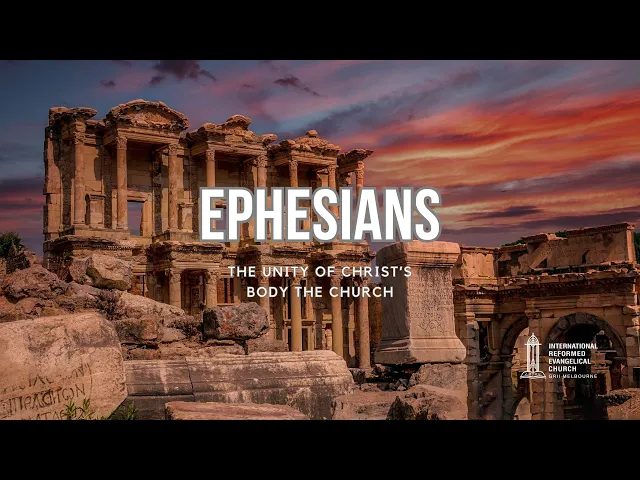

Life Worthy of the Calling
Series:
New Testament
Book:
Ephesians

Rev. Budy Setiawan
The sermon opens a new major section of Ephesians, moving from the doctrinal exposition of chapters 1-3 into the practical application of chapters 4-6. The preacher notes a striking pattern: of the 41 imperative commands found throughout the letter, only one appears in the first three chapters, while the remaining forty are concentrated in chapters 4-6. This statistic marks Ephesians 4:1 - "Therefore I urge you" - as a genuine turning point, paralleling the same structural hinge in Romans, where chapters 1-11 of doctrine give way to chapters 12-16 of exhortation beginning with "Therefore, I urge you, brothers, by the mercies of God." The sermon argues that this parallel is not incidental: Paul consistently grounds ethical exhortation in prior doctrinal truth, never the reverse.
From this pattern the sermon draws its central thesis: practical Christian living must rest on doctrinal foundations, or it collapses. The preacher warns against the popular slogan "deeds, not creeds" - the impulse to skip doctrine and jump straight to loving, serving, and moral behavior - as a serious misreading of Paul. Without understanding why believers do what they do, external conformity to Christian behavior produces mere Pharisaism: whitewashed tombs, clean and impressive outwardly but full of decay within. Children taught only the "do's and don'ts" of Christianity, without the doctrinal "why" behind prayer, Bible reading, and worship, come to experience obedience as imprisonment and compulsion rather than joyful response. Real Christian ethics, the sermon insists, must be theologically oriented rather than merely practically oriented.
Paul introduces this first command - "walk worthy of the calling" - by first identifying himself as "a prisoner for the Lord." The sermon suggests two reasons for this self-description: first, that Paul is underscoring how precious this calling is, precious enough that he is willing to be imprisoned for proclaiming it; second, that he is warning the Ephesians that faithfully living out this same calling may likewise cost them dearly. The Greek word translated "walk" (peripateo) appears eight times in Ephesians and thirty-three times across Paul's letters, and the sermon traces its use through the book: in 2:1-2 believers once "walked" in trespasses and sins, following the course of this world; in 2:10 they are now God's workmanship, created for good works that God prepared beforehand, "that we should walk in them"; and in 5:8, summarizing the trajectory, "you were once darkness, but now you are light in the Lord; walk as children of light."
The sermon then unpacks the double use of "calling" in verse 1: believers are described both as "those who have been called" and as summoned "to walk worthy of the calling." The first sense addresses identity - who we are, as those effectually called by God. The preacher compares this to Jesus calling Lazarus out of the tomb: Lazarus could not have responded to the call unless the call itself first gave him life, and this is exactly the pattern of the effectual call described in reformed theology, illustrated from 1 Corinthians 1:22-24, where the message of the cross is foolishness to some but is "the power of God and the wisdom of God" to those who are called. The second sense of "calling" addresses purpose and hope - what believers are called toward. The sermon points to Ephesians 1:3-7 (adoption, redemption, the praise of God's glorious grace) and 1:18 (Paul's prayer that believers may know "the hope to which he has called you") as summarizing this goal: a life set apart in holiness, adopted as God's children, destined for the riches of his glorious inheritance.
The sermon closes with two illustrations of what living out of step with this calling looks like. Negatively, Ephesians 5:3-4 lists sexual immorality, impurity, covetousness, and coarse or foolish talk as "improper" - literally, not fitting or corresponding to the calling - to be replaced instead with thanksgiving. Positively but cautionarily, the preacher offers an extended pastoral example: a wife who, out of necessity, takes over a negligent husband's business and household responsibilities, rescuing the family financially but inadvertently stripping her husband of his role and dignity, driving him to seek affirmation elsewhere. This, the sermon argues, illustrates the cost of addressing only the practical symptom of a problem without understanding and honoring the deeper theological and relational principles at stake - a "rollercoaster" pattern of recurring dysfunction that never resolves because its root causes are never named. The congregation is urged to return each week as the series unfolds this "walk worthy" principle into fuller practical detail.
Bible Verses Used
Ephesians 4:1-6: The sermon's main text; introduces the command to "walk worthy of the calling," grounding all following ethical instruction in prior doctrine.
Romans 11:36 and 12:1: Cited as a structural parallel showing Paul's consistent pattern of doctrine (chs. 1-11) followed by exhortation beginning "therefore" (chs. 12-16).
Ephesians 2:1-2: Illustrates the negative sense of "walking" - the former life of following the course of this world before the calling.
Ephesians 2:10: Shows believers as God's workmanship created to "walk" in the good works God prepared beforehand.
Ephesians 5:8: Summarizes the trajectory of the "walk" motif - from darkness to walking as children of light.
1 Corinthians 1:22-24: Used to explain the doctrine of effectual calling - the same gospel is foolishness to some but the power and wisdom of God to those who are called.
Ephesians 1:3-7: Cited to show the content and goal of the calling - adoption, redemption, and the praise of God's glorious grace.
Ephesians 1:18: Paul's prayer that believers may know "the hope to which he has called you," summarizing the purpose of the calling.
Philippians 1:27: Parallel exhortation to "let your manner of life be worthy of the gospel of Christ," reinforcing the "walk worthy" theme.
Ephesians 5:3-4: Gives concrete negative examples (immorality, impurity, coarse talk) of conduct that does not correspond to, or is unfitting for, the calling.
Read more
Previous
The Great Commission
Next
