

Called to Follow, Called to Suffer
Series:
New Testament
Book:
Luke

Rev. Budy Setiawan
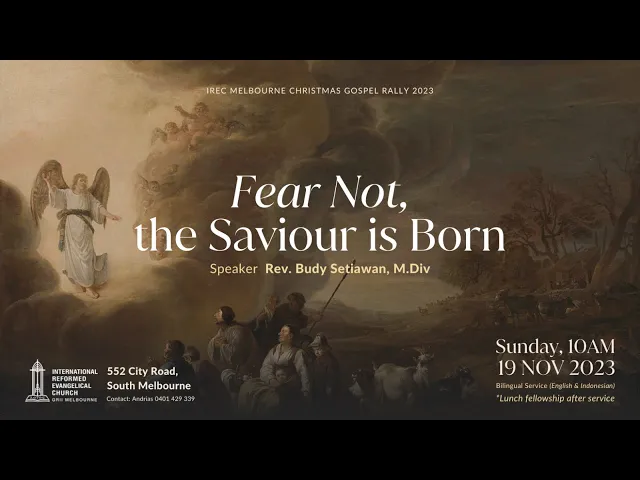
The sermon opens in Luke 2:1-14, the familiar Christmas narrative of Caesar Augustus's census, Joseph and Mary's journey to Bethlehem, and the angelic announcement to the shepherds. The preacher frames the whole message around the angel's words, "Fear not, for behold, I bring you good news of great joy that will be for all the people. For unto you is born this day in the city of David, a Savior, who is Christ the Lord" (Luke 2:10-11), arguing that this proclamation is as urgent for Christmas 2023 as it was two thousand years ago. The world is described as gripped by fear: the war in Ukraine now stretching past a year and nine months, the Gaza conflict already surpassing Ukraine's death toll within forty-two days and sparking protests as far away as Melbourne, alongside the private fears everyone carries — anxiety about the future, fear of failure or rejection, fear of sickness and death.
Before unpacking the good news itself, the sermon insists on the historicity of the nativity. Luke, a careful historian, roots Christ's birth in real time and geography: the reign of Caesar Augustus (31 BC-AD 14), the governorship of Quirinius in Syria, and Joseph's roughly 150-kilometer, three-day journey from Nazareth to Bethlehem with his pregnant fiancée. This journey fulfills Micah 5:2, that a ruler "whose coming forth is from of old, from ancient days" would come from Bethlehem Ephrathah. The preacher notes that Bethlehem, ten kilometers from Jerusalem, sits today in the tense, war-torn West Bank — once thronged with Christmas pilgrims, now empty and shaken by the sound of bombs — underscoring that Christ was born into a real, troubled world, a city as ordinary as Melbourne or Jakarta, yet chosen by God before the foundation of the world.
The sermon then turns to why humanity needs a Savior at all. It traces the fracture back to Eden: God gave Adam and Eve freedom to enjoy all of creation except the tree of the knowledge of good and evil, but the serpent sowed doubt about God's goodness, convincing Eve that God's command was a restriction rather than a kindness. Their disobedience broke shalom — relationship with God, with each other, and within themselves — replacing it with fear, blame ("the woman you gave me"), and hiding from God's presence. The preacher argues that every fear experienced today, from war to loneliness, ultimately traces back to this ruptured relationship with God.
This sets up the sermon's central move: the Christmas announcement of "peace on earth among those with whom he is pleased" (Luke 2:14) is fundamentally about being reconciled to God. Romans 5:1 is cited to show that justification by faith in Christ, not by birth, baptism, church membership, or good works, is what grants peace with God. Drawing on Psalm 24:3-4, the sermon stresses no one — not the preacher, not any religious leader — has clean hands and a pure heart to ascend God's hill on their own merit. Instead, echoing Luther's image of faith as a beggar's outstretched hand, and the tax collector of Luke 18 who could not lift his eyes yet went home justified, the sermon insists righteousness comes only through union with Christ, who "knew no sin" but "was made sin for us, so that we might become the righteousness of God" (2 Corinthians 5:21).
From peace with God, the sermon extends to inner peace and peace with others. It cites alarming loneliness statistics — a third of adults worldwide report loneliness, which raises risk of early death by 39% and heart disease by 53%, comparable to smoking fifteen cigarettes a day — worsened by social media and especially acute at Christmas, when suicide rates spike. Philippians 4:6-7 is offered as the antidote: anxiety yields to prayer, and "the peace of God, which surpasses all understanding" guards the heart in Christ. Finally, turning to relationships strained by family gatherings over the holidays, the sermon acknowledges from Romans 12:18 that peace with others is not fully within one's control, but calls the congregation to Ephesians 4:31-32 — putting away bitterness and slander, forgiving one another as God in Christ forgave them — as the fruit of having first received God's forgiveness. The sermon closes with an invitation to respond to the Christmas call: to be reconciled to God through faith in Christ, who died and rose to secure that peace.
Bible Verses Used
Luke 2:1-14: The primary text; the census, nativity, and angelic announcement frame the whole sermon's message of "fear not" and peace on earth.
Micah 5:2: Shows that Christ's birth in Bethlehem fulfilled ancient prophecy, proving God's sovereign plan behind the census.
Galatians 4:4: Cited to affirm that Christ was born "when the fullness of time had come," reinforcing the sermon's point about God's sovereign timing.
Genesis 3 (Adam and Eve's fall): Used to explain the origin of humanity's fear and broken relationship with God, others, and self.
Romans 5:1: Grounds the claim that justification by faith in Christ, not works, secures peace with God.
Romans 3: Referenced to establish universal human sinfulness and the need for justification.
Psalm 24:3-4: Used to show no one can claim clean hands and a pure heart before God apart from grace.
Luke 18:9-14 (the tax collector and the Pharisee): Illustrates true faith as humble reliance on mercy rather than self-righteous claims.
2 Corinthians 5:21: Explains substitutionary atonement — Christ made sin for us so we are made righteous in him.
Philippians 4:6-7: Applied to anxiety and loneliness, offering God's peace that surpasses understanding as the answer.
Romans 12:18: Used to realistically frame peace with others as dependent on both parties, not solely one's own effort.
Ephesians 4:31-32: Closes the sermon's call to forgive others and put away bitterness, modeled on God's forgiveness in Christ.
Read more
Previous
Lord's Prayer 2
Next
