

Christ's Ambassadors
Series:
New Testament
Book:
2 Corinthians

Rev. Lim Yi Jin
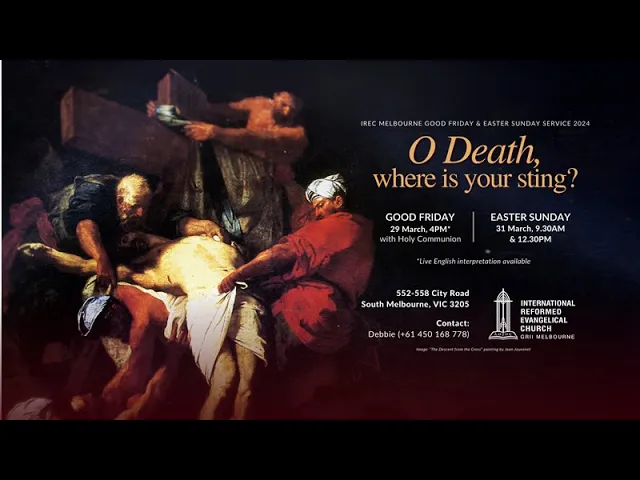
The sermon opens on Easter Sunday with a reading of 2 Corinthians 5:14-21 and a personal story from the preacher's boyhood, in which a mother's undeserved, sorrowful love for a rebellious son becomes the entry point into the sermon's central claim: to be loved with a selfless love one does not deserve is a love that "wrecks" a person and remakes them. That love, the sermon argues, was put on full display at Calvary, where Jesus was betrayed, falsely accused, flogged, mocked as king, and crucified. The preacher stresses that this was no accident but the deliberate will of the Lord, citing the pattern of Isaiah's suffering servant, who was crushed for the iniquities of his people. The cross is framed as the ultimate expression of a God who did not withhold his only Son so that whoever believes might not perish but have eternal life; Jesus, the sermon insists, willingly signed up for every part of his suffering because he loved his people.
Turning to the text, the sermon distinguishes Paul's phrase "the love of Christ controls us" as Christ's love for believers rather than believers' love for Christ, a love demonstrated in his voluntary death. The sermon unpacks verses 14 and 21 as containing the mysteries of a "great exchange": first, the death of Jesus counts as the believer's death, satisfying the wages of sin and standing in the place of sinners before the judgment seat of God, who alone is fair and just and before whom no one is found blameless. Though sinless, Jesus was legally declared sin for his people so that, in him, sinners are counted righteous. Second, the sermon explains righteousness as a legal standing, a declaration that one is right before God and therefore fit for relationship with him; since all people fall short through greed, pride, and disordered loves, no one can claim to be "good enough" by a self-invented standard, since only the Creator has the right to define and judge righteousness. Jesus, having lived a perfectly obedient life, is declared righteous, and he freely shares that righteousness with his people.
The sermon then asks how sin and righteousness can be exchanged between Christ and believers, answering that it is because believers have been made one with him. Union with Christ is traced through verses 17 and 19 and Jesus's high priestly prayer for oneness with his people, and is described as a mutual but unequal belonging: Christ takes on the believer's sin and gives his own righteousness in return, and through this exchange God reconciles sinners to himself, not counting their trespasses against them and instead entrusting believers with the ministry of reconciliation.
Having established the nature of Christ's love, the sermon turns to the natural response such love should provoke and to the obstacles that hinder it. Some fail to love Christ back because they misunderstand his love the way children misread parental discipline as hatred, treating him merely as a friend rather than as the one who died for them and who has the right to rule their lives; others simply love something else more, so that a rival love crowds out love for Christ. The sermon then addresses verse 15's claim that believers no longer live for themselves but for the one who died and was raised for them, confronting the modern instinct to prize unrestricted personal freedom. Using Romans 6, the sermon argues that freedom without Christ is not true freedom but slavery to sin, comparing the sinner's relationship to sin to a dog that will leap back into the mud unless its heart, not merely its circumstances, is changed. A story of gang-affected teenagers whose parents welcome the church's moral influence but forbid their baptism illustrates the same point: many want the blessings of Christ without submitting to him, not realizing that freedom from sin and glad submission to Christ are two sides of one coin. True freedom, the sermon concludes, is the power to remain consistently faithful to what is right, a power Christ himself supplies by radically transforming those he saves.
The sermon closes by expounding verse 17's declaration that anyone in Christ is a new creation, an exclamation rather than a mere description, and connects Christ's resurrection to the believer's future bodily resurrection in a state of imperishable perfection. Because Christians are seen "in Christ" rather than "according to the flesh," they are no longer defined by their failures, just as Christ himself is no longer rightly regarded as a failed, foolish man but as the crucified and risen Lord whose apparent foolishness is in fact the power of God. The sermon ends with a direct evangelistic appeal drawn from verses 19-20: believers are Christ's ambassadors carrying God's own appeal, and hearers are urged, on this Easter Sunday, to receive the freely given message of reconciliation and be reconciled to God, closing in a prayer affirming the hope of bodily resurrection and eternal life with Christ.
Bible Verses Used
2 Corinthians 5:14-21: The sermon's primary text, expounding Christ's controlling love, substitutionary death, the believer's new creation, and the ministry of reconciliation.
Isaiah's suffering servant (Isaiah 53): Cited to show the crucifixion was the sovereign will of God, not an accident, as Christ was crushed for the iniquities of his people.
John 3:16 (allusion): Referenced to explain that God gave his only Son so that believers would not perish but have eternal life.
Romans 6: Used to argue that freedom apart from Christ is slavery to sin, while submission to Christ is true freedom leading to righteousness and eternal life.
John 17 (high priestly prayer, allusion): Cited to show Jesus prayed for oneness with his people, grounding the sermon's teaching on union with Christ.
Read more
Previous
Resurrection Hope
Next
